
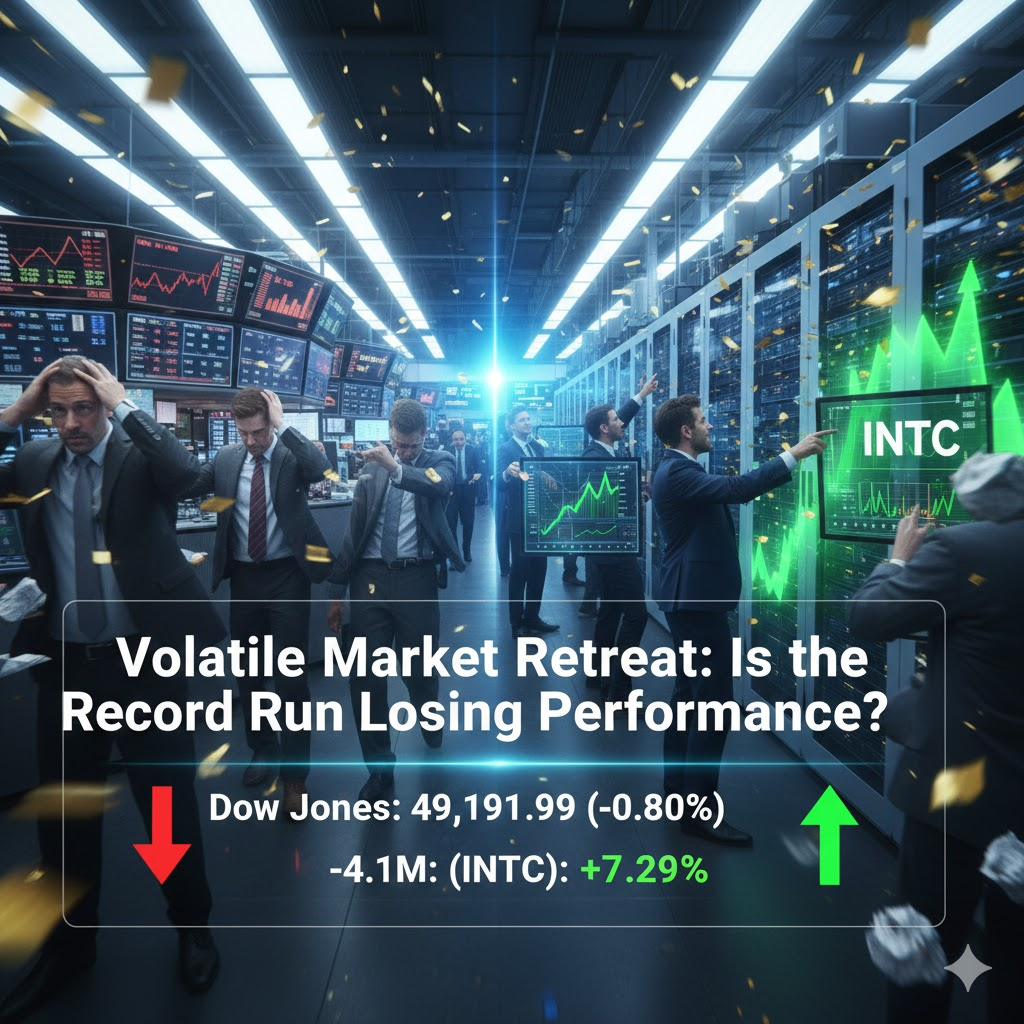
The purpose of this post is to summarize the complex movements of the U.S. stock market with a data-centric approach to identify dominant themes and help readers proactively establish strategies for the next trading day. On January 13, 2026, the global Performance of major indices took a step back as investors navigated a dense fog of economic data and corporate earnings. Following a historic session where the Dow and S&P 500 set all-time records, the market entered a “profit-taking” phase. This shift was largely triggered by a mixed start to the fourth-quarter earnings season, particularly within the banking sector, which overshadowed a relatively “cool” inflation report. Consequently, market sentiment is currently characterized by “cautious repositioning” as the initial euphoria of 2026 meets the reality of corporate guidance.
1. Market Snapshot Performance
According to the latest aggregated real-time data from Yahoo Finance and Investopedia, the primary U.S. indices retreated from their peaks during Tuesday’s session:
- Dow Jones Industrial Average: 49,191.99 (-0.80%) — Shed nearly 400 points
- S&P 500: 6,963.74 (-0.19%) — Pulled back from record 6,977 close
- Nasdaq Composite: 23,709.87 (-0.10%) — Slightly lower despite chip sector strength
- CBOE Volatility Index (VIX): 14.95 (+3.18%)
The Performance across the board reflects a market that is highly sensitive to earnings quality. While the tech-heavy Nasdaq showed resilience thanks to a massive rally in semiconductors, the broader Dow was weighed down by heavyweights in the financial and software sectors. Trading volume remained elevated as institutions rebalanced portfolios ahead of more significant retail and bank data releases later this week.
2. Core Drivers of Market Performance
- Mixed Inflation Data and Fed Expectations: The December Consumer Price Index (CPI) matched expectations with a 2.7% year-over-year rise, while “core” CPI came in slightly below consensus at 2.6%. Although this initially buoyed hopes for Federal Reserve rate cuts in 2026, the Performance of the bond market remained stable, with the 10-year Treasury yield hovering around 4.17%. The data reinforced bets that the Fed might stay on hold this month, leading to a “sell the news” reaction in equities.
- Banking Sector Struggles and Policy Risks: Disappointing results from JPMorgan Chase acted as a major drag on the Performance of the financial sector. The bank took a $2.2 billion hit related to its partnership with Apple, while broader concerns grew over President Trump’s proposal to cap credit card interest rates at 10%. This regulatory uncertainty triggered a sharp decline in major lenders and credit card issuers like Visa and Mastercard, which were among the biggest decliners in the S&P 500.
- AI Hardware Momentum Snaps Tech Slide: In contrast to the broader retreat, the semiconductor sector delivered a standout Performance. Analyst upgrades for Intel and AMD, citing “largely sold out” server CPU capacity for 2026, sparked a significant rally. This indicates that while software companies like Salesforce struggled due to competition concerns, the “picks and shovels” of the AI buildout—specifically hardware and foundries—continue to attract massive capital inflows.
3. Intel Corp (INTC) Performance Analysis
- Current Price: $47.27
- Target Price: $55.00 (Reflecting 18A foundry potential)
- Highlight: Intel emerged as a dominant Performance leader, surging 7.29%. According to The Motley Fool, KeyBanc analysts upgraded the stock to “overweight,” citing overwhelming demand for its AI server CPUs and the credibility of its new “18A” production method. Intel’s ability to potentially become the #2 foundry supplier globally has fundamentally reframed its turnaround story for 2026.
4. JPMorgan Chase (JPM) Performance Drag
- Current Price: $234.12 (estimated based on -4.19% move)
- Target Price: $255.00
- Highlight: JPMorgan Chase saw its worst one-day Performance in months, plummeting 4.19%. As reported by Xinhua, the bank’s earnings were marred by a massive hit from its Apple Card partnership. Additionally, CEO Jamie Dimon’s warnings about the 10% credit card rate cap proposal added a layer of systemic risk that cooled investor enthusiasm for the entire banking sector.
5. Salesforce (CRM) Performance Decline
- Current Price: $312.45 (estimated based on -7.1% move)
- Target Price: $345.00
- Highlight: Salesforce was the worst-performing stock in the Dow, dropping roughly 7.1%. The decline followed an update to its virtual assistant feature in Slack, which failed to impress a Performance-hungry market. Competition in the AI agent space is intensifying, and investors are increasingly demanding proof of monetization rather than just feature announcements.
6. Actionable Strategy and Performance Outlook
The current Performance of the market suggests that the “easy money” phase of the January rally may be transitioning into a “stock-picker’s market.” While the Dow 49,000 level remains a critical psychological support, the divergence between hardware AI (Intel/AMD) and software/banking indicates where the next leg of growth will likely originate.
For the next trading session, investors should monitor the $23,750 level on the Nasdaq; a breakout here could signal that AI hardware remains the primary engine of the market. Conversely, if banking stocks fail to stabilize, we could see a deeper retest of the 6,900 level on the S&P 500. For refined stock picks and real-time data crossing, visiting DailyStockPicksAI will provide the necessary edge. The strategy should favor high-conviction AI hardware while remaining underweight on financial services until there is more clarity on credit card interest rate caps.