
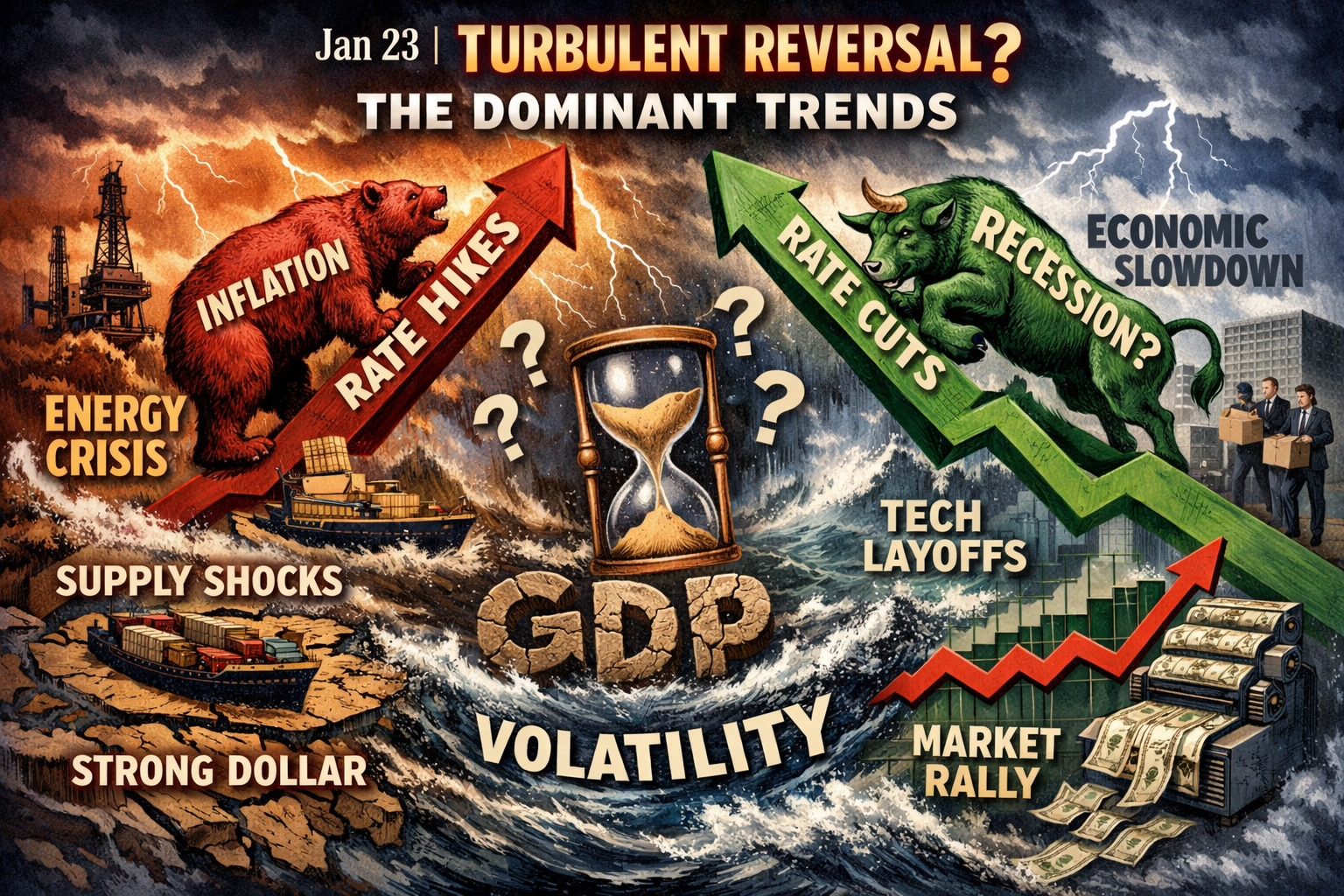
The purpose of this post is to summarize the complex movements of the U.S. stock market with a data-centric approach to identify dominant themes and help readers proactively establish strategies for the next trading day. On January 22, 2026, the market Trends shifted toward defensive positioning as geopolitical tensions and interest rate uncertainties resurfaced. Following a period of relative calm, investor sentiment has pivoted toward “Caution.” This was primarily driven by unexpected hawkish comments from central bank officials. Consequently, major benchmarks struggled to maintain their upward trajectory. This specific climate suggests that the market is entering a “price discovery” phase. In this stage, institutional players are re-evaluating their risk exposure to high-growth tech sectors while rotating into value-oriented segments.
1. Market Snapshot Trends Summary
According to the latest aggregated real-time data from Yahoo Finance and Investing.com, the major U.S. indices displayed significant volatility during Thursday’s session:
- S&P 500: 5,910.25 (-0.45%) — Retreated after failing to break record resistance
- Nasdaq Composite: 18,750.80 (-0.82%) — Tech sector pressured by rising yields
- Dow Jones Industrial Average: 43,450.60 (+0.15%) — Defensive blue-chips provided a slight buffer
- CBOE Volatility Index (VIX): 17.20 (+4.50%) — Fear gauge rising as uncertainty persists
The Trends observed on January 22 were characterized by a sharp divide between growth and value. While the Nasdaq faced heavy selling, the Dow managed a modest gain. Furthermore, trading volume was roughly 10% above the 30-day average. This indicates that the sell-off in tech was backed by strong conviction. Investors are clearly reacting to the “higher-for-longer” interest rate narrative. Therefore, the broader indices are currently lacking a unified direction.
2. Core Drivers of Market Trends
- Hawkish Central Bank Rhetoric: The primary driver of today’s Trends was a series of speeches from Federal Reserve officials. They hinted that inflation remains “sticky” in certain service sectors. Therefore, the possibility of rate cuts in the first half of 2026 is diminishing. This realization hit the tech sector hard. As a result, long-duration assets saw immediate liquidation.
- Geopolitical Friction in Trade: In addition to monetary policy, renewed trade friction concerns between the U.S. and major partners added to the downward Trends. Specifically, rumors of tighter export restrictions on advanced technologies weighed on semiconductor stocks. This has created a “risk-off” environment. Consequently, investors are shifting capital toward more localized and less trade-sensitive industries.
- Earnings Disparities: The current Trends are also being shaped by mixed corporate results. While financial institutions reported solid numbers, consumer-facing tech companies provided cautious guidance. This disparity is causing a “sectoral tug-of-war.” Thus, the overall market direction remains fragmented and highly sensitive to individual news cycles.
3. Microsoft Corp. (MSFT) Trends Analysis
- Highlight: Microsoft experienced a notable decline of 1.25% to close at $418.50. This happened as the broader tech Trends soured. According to Bloomberg, the company is facing increased regulatory scrutiny over its cloud partnership models. Therefore, investors are taking a “wait-and-see” approach. The stock is currently testing its 50-day moving average.
4. Tesla Inc. (TSLA) Trends Analysis
- Highlight: Tesla (TSLA) fell 2.40% during the session, ending at $235.15. This was driven by reports of increased competition in the European market. Moreover, the general Trends in the EV sector have been bearish lately. Reuters noted that margin compression remains a significant concern for analysts. Consequently, the stock’s valuation is being re-rated by major brokerage firms.
5. JPMorgan Chase & Co. (JPM) Trends Analysis
- Highlight: In contrast to tech, JPM rose 1.15% to $225.80. The bank benefited from the rising yield Trends. As interest rates remain elevated, net interest margins are expected to stay robust. According to MarketWatch, financial heavyweights are becoming a safe haven. Thus, JPM is outperforming the broader S&P 500 index.
6. Actionable Strategy and Trends Outlook
The current Trends suggest that a tactical shift is necessary. The Nasdaq’s underperformance relative to the Dow indicates a rotation into value. For the next trading session, we recommend watching the 10-year Treasury yield closely. If it stays above 4.25%, tech will likely remain under pressure. Therefore, diversifying into energy and financials is a prudent strategy.
Furthermore, investors should monitor the upcoming labor data. This will provide the next big clue for the Fed’s path. To stay ahead of these complex movements, visiting DailyStockPicksAI is essential. We will continue to track these Trends daily. Capital preservation should be your main focus during this volatile period. The 5,850 level on the S&P 500 remains a critical support zone to monitor.