
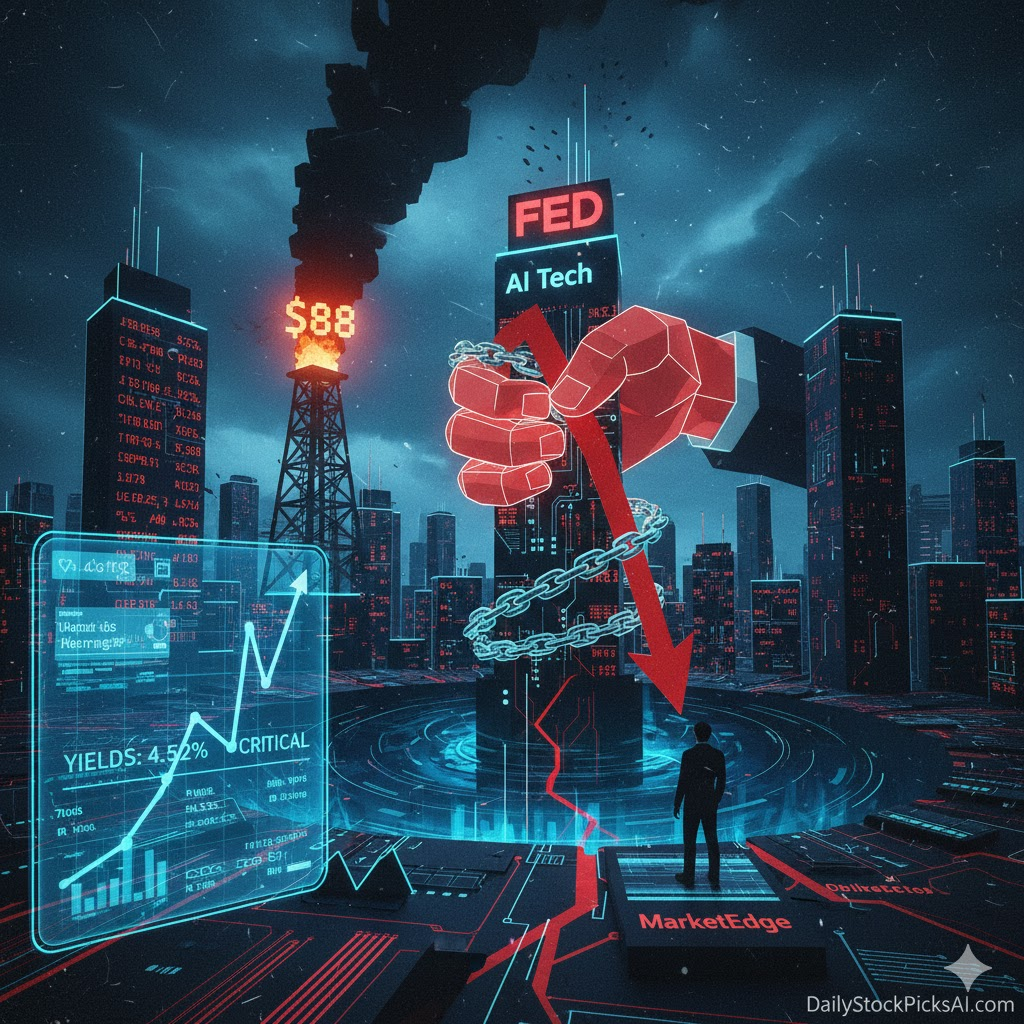
To begin with, the global financial landscape is facing a pivotal moment as we analyze the latest MarketEdge signals. Specifically, investors are reacting to an unexpected surge in the 10-year Treasury yield, which has crossed the critical 4.5% threshold. Consequently, this development has introduced a fresh wave of uncertainty into the MarketEdge for the first full trading week of 2026. Institutional players are now aggressively hedging against a potential “higher-for-longer” monetary regime that few expected so early in the year. You can monitor the real-time impact on market indices and bond yields through Yahoo Finance (https://finance.yahoo.com).
1. The Ominous Yield Surge and MarketEdge Analysis
First, the benchmark 10-year Treasury yield surged to a multi-month high of 4.52% during early trading hours. While the market hoped for a stabilization of borrowing costs, the latest data suggests that inflation expectations are becoming unanchored. In addition, this MarketEdge shift has triggered an automatic sell-off in duration-sensitive assets like high-growth tech stocks. According to Investing.com (https://www.investing.com), this yield volatility is the primary catalyst for the current “de-risking” phase observed across major desks.
Furthermore, the Federal Reserve’s latest commentary revealed a surprisingly unified stance on maintaining restrictive levels well into the fiscal year. Therefore, the probability of a first-quarter rate cut has essentially evaporated, leaving equity markets without a primary bullish driver. This pivot in monetary sentiment is a core MarketEdge component today, as investors move toward capital preservation over speculation. Moving forward, the focus will shift to the upcoming PPI data to see if wholesale costs are mirroring consumer trends.
NVIDIA (NVDA)
In addition, NVIDIA (NVDA) is experiencing a brutal 3.8% correction today as the “AI premium” meets the reality of high yields. Since NVDA’s valuation relies on future cash flows, higher discount rates make the stock appear significantly more expensive. Consequently, the stock is testing major support levels as institutional investors trim their overweight positions in the semiconductor giant.
2. MarketEdge: Geopolitical Escalation and the Oil Shock
In addition, WTI Crude oil futures have jumped 3.5% overnight due to intensified disruptions in global energy corridors. Because energy is a foundational input for almost every sector, this sudden price hike threatens to reignite headline inflation. Consequently, the MarketEdge regarding global supply chain stability has turned increasingly bearish, with logistics costs projected to rise. Reuters (https://www.reuters.com) reports that shipping insurance premiums have quadrupled, adding another layer of cost to international trade.
Moreover, the spike in oil is acting as a “stealth tax” on the global consumer, further eroding discretionary spending power. Since gasoline prices are a highly visible inflation indicator, this move is likely to sour consumer sentiment further. The MarketEdge suggests that energy-intensive industries, such as chemicals and heavy manufacturing, will face significant margin compression. In conclusion, the energy shock is complicating the Fed’s mission, making a “soft landing” look increasingly like a fantasy.
EXXON MOBIL (XOM)
Furthermore, Exxon Mobil (XOM) is one of the few bright spots today, gaining as Brent Crude nears $88. Therefore, it is serving as a crucial hedge for portfolios currently bleeding from tech exposure during this volatility. Moving forward, XOM’s performance will be a direct reflection of the severity of the ongoing geopolitical supply constraints.
3. The Treacherous Tech Rotation and MarketEdge
On the other hand, a treacherous rotation is taking place as fund managers quietly exit AI-driven names for value plays. Therefore, the Nasdaq 100 is significantly underperforming the Dow Jones Industrial Average today, signaling a major structural shift. This valuation fatigue is a critical component of our MarketEdge, as the “AI hype cycle” meets sustained high rates. The Wall Street Journal (https://www.wsj.com) notes that institutional cash levels have hit their highest point in six months.
Furthermore, the regulatory landscape for Big Tech is darkening with new antitrust filings in the European Union targeting cloud ecosystems. Since these companies rely on integrated services for high margins, any forced decoupling could be catastrophic for growth rates. The MarketEdge for the tech sector is now one of extreme caution and defensive positioning among large-cap funds. In addition, retail investors who entered at the 2025 highs are now facing significant risk as support levels break.
MICROSOFT (MSFT)
In addition, Microsoft (MSFT) is under intense pressure today as higher yields and regulatory headwinds create a “double whammy” effect. While its AI integration remains a long-term strength, the short-term MarketEdge suggests that the stock is overdue for a correction. Consequently, MSFT is dragging down the broader software sector as it retreats toward its 50-day moving average.
4. Institutional Pessimism: JP Morgan’s MarketEdge Warning
In addition, JP Morgan’s lead strategist issued a scathing report this morning regarding the “dangerously low” equity risk premium. Since bonds now offer a competitive yield relative to stocks, the MarketEdge favors a massive asset reallocation out of equities. Furthermore, the bank suggests that corporate earnings for 2026 are likely to be revised downward by institutional analysts. Bloomberg (https://www.bloomberg.com) reports that institutional “sell” orders have outweighed “buy” orders significantly in today’s pre-market session.
Moreover, the report highlights the growing risk of a “liquidity void” if the current sell-off in growth names accelerates. Consequently, market depth is thinning, which could lead to larger-than-expected price swings in either direction for individual stocks. The MarketEdge is clear: the margin for error for equity investors has completely vanished for the current quarter. Therefore, the bank is recommending an overweight position in short-term T-bills and defensive consumer staples like tobacco and food.
PROCTER & GAMBLE (PG)
Consequently, Procter & Gamble (PG) is seeing a flight-to-safety bid as investors seek shelter in its recession-proof product line. Since consumer staples are often the last to fall in a broader market correction, this MarketEdge highlights PG as a primary vehicle.
5. MarketEdge: The Retail Capitulation Signal
Finally, data from major retail brokerage platforms indicates a surge in “panic selling” among small-cap traders over the last day. However, many contrarian indicators suggest that this retail capitulation might be necessary for a medium-term bottom to eventually form. Moving forward, the MarketEdge will depend on whether institutional buyers step in to provide support at these new technical levels. More detailed analysis and real-time alerts on these market shifts can be found at DailyStockPicksAI (https://dailystockpicksai.com/).
TESLA (TSLA)
Therefore, Tesla (TSLA) is being watched as the ultimate barometer of retail sentiment during this market-wide liquidation phase. While the stock is down today, a recovery here would signal that the “buy the dip” mentality is still present. In conclusion, TSLA’s ability to hold its current support will be a key signal for the broader MarketEdge.
💡 MarketEdge: Investor Outlook
In summary, the current MarketEdge is dominated by the reality of rising yields, energy shocks, and institutional de-risking. Moving forward, investors should prioritize liquidity and focus on companies with fortress balance sheets and significant pricing power. The “Goldilocks” era of low rates and high growth is officially over for the foreseeable future in 2026. Navigating this MarketEdge requires a disciplined approach, favoring value over hype and defensive hedges over speculative bets. Expect continued volatility as the market searches for a new equilibrium in this treacherous environment.