
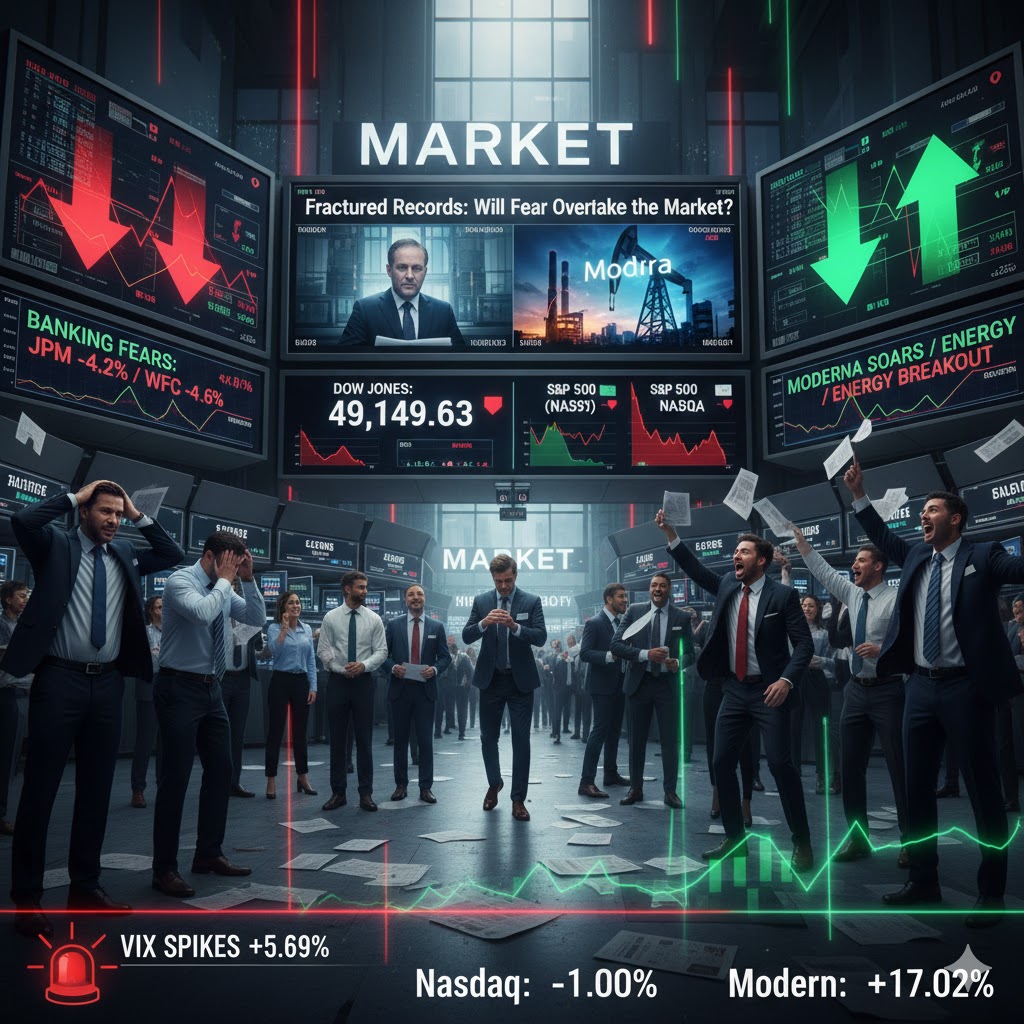
The purpose of this post is to summarize the complex movements of the U.S. stock market with a data-centric approach to identify dominant themes and help readers proactively establish strategies for the next trading day. On January 14, 2026, the global Market faced a sobering reality check as major indices retreated from their historic highs. After a week of exuberant “Extreme Greed,” the sentiment has rapidly shifted toward a “profit-taking” and “cautious repositioning” phase. This volatility was primarily fueled by a collision between disappointing bank earnings and heightened regulatory concerns, effectively snapping the consecutive record-breaking streak of early 2026. Consequently, the prevailing sentiment is transitioning from unbridled optimism to a “fear-induced” wait-and-see approach as investors digest the implications of new policy proposals and cooling economic data.
1. Market Snapshot Performance Summary
According to the latest aggregated real-time data from Yahoo Finance and Morningstar, the major U.S. indices finished Wednesday in negative territory:
- Dow Jones Industrial Average: 49,149.63 (-0.09%) — Held steady above 49k despite pressure
- S&P 500: 6,926.60 (-0.53%) — Largest one-day decline since Dec 31, 2025
- Nasdaq Composite: 23,471.75 (-1.00%) — Led the slide on tech and chip weakness
- CBOE Volatility Index (VIX): 15.98 (+5.69%) — “Fear Gauge” spiking as uncertainty grows
The Market volume was notably higher than average, reaching 18.68 billion shares traded. This indicates that the sell-off was accompanied by significant conviction, particularly as the S&P 500 again failed to maintain the 7,000 psychological barrier. While advancers slightly outnumbered decliners on the NYSE, the Nasdaq saw a clear bearish skew, reflecting a targeted exit from high-multiple growth stocks.
2. Core Drivers of the Current Market
- Banking Sector Earnings and Regulatory Turmoil: The primary driver of the Market downturn was a flurry of mixed bank earnings paired with regulatory anxiety. While Bank of America and Citi largely beat profit estimates, their shares fell as much as 4.6% due to tempered 2026 guidance. Furthermore, President Trump’s proposal to cap credit card interest rates at 10% continues to haunt the financial sector, leading to a broader sell-off in major lenders like Wells Fargo and Citigroup according to Investopedia.
- Geopolitical Chip Restrictions and Tech Retreat: The technology sector, particularly semiconductors, faced renewed pressure. Reports that Chinese authorities are restricting certain U.S.-made chips and cybersecurity software caused heavyweights like Nvidia and Broadcom to retreat. This geopolitical tension introduced a fresh layer of risk to the Market, overshadowing previously solid retail sales data.
- Inflation Digest and Bond Yield Softening: Macro data provided a silver lining as Core CPI rose only 0.2% month-over-month, lower than the 0.3% consensus. This “cool” inflation report led to a drop in the 10-year Treasury yield to 4.14%. However, the Market focused more on earnings quality than interest rate relief, suggesting that the “inflation-hedge” trade is temporarily taking a backseat to “earnings-risk” management.
3. Nvidia (NVDA) Market Impact Analysis
- Target Price: $210.00
- Highlight: Nvidia became a focal point of the Market‘s tech retreat, falling 1.44% to close at $183.14. As reported by The Motley Fool, the slide was triggered by reports of Chinese regulatory retaliation against U.S. hardware. NVDA’s struggle to maintain its momentum is a critical signal for the broader AI theme, which has been the primary engine of the 2026 bull market.
4. Wells Fargo (WFC) Market Performance
- Target Price: $75.00
- Highlight: Wells Fargo was among the biggest laggards in the Market, sinking 4.61% after reporting mixed fourth-quarter results. Investors were particularly rattled by the bank’s cautious outlook on net interest income for 2026. According to Nasdaq, the combination of earnings misses and the looming threat of interest rate caps on credit cards makes WFC a high-volatility play in the near term.
5. Moderna (MRNA) Market Outperformance
- Target Price: $115.00
- Highlight: In a stark contrast to the broader Market, Moderna soared 17.02% in a single session. This massive gain was fueled by positive clinical data or sector-specific tailwinds that provided a haven for investors seeking growth outside of the crowded tech and financial sectors. MRNA’s breakout suggests that the “smart money” is actively searching for idiosyncratic growth stories to hedge against index-level volatility.
6. Actionable Strategy and Market Outlook
The current Market behavior suggests a transition from a broad-based rally to a more selective, defensive environment. With the VIX rising over 5%, the immediate strategy should favor sectors with high cyclical resilience, such as Consumer Staples and Energy, which led the gainers today. The Dow 49,000 level acts as a critical line in the sand; as long as this holds, the long-term bullish structure remains intact.
For the next trading session, watch for the Supreme Court’s potential tariff ruling, which could inject further volatility into global trade-sensitive stocks. Investors should consider rebalancing away from banks until regulatory clarity on rate caps emerges. For those seeking real-time alerts on these rapid sector rotations, visiting DailyStockPicksAI will provide the necessary data edge. The Market is currently at a crossroads—maintaining liquidity while looking for “safe-haven” growth like Moderna could be the winning move for the remainder of the week.